Ver categorias
Explorar
Fiverr Pro
Português
$
USD

Electrical Engineer
Habilidades
Conheça meus serviços
Electronic Engineer trainee
Microchip solutions • Período integral
Nov 2025 - Present • 6 mos
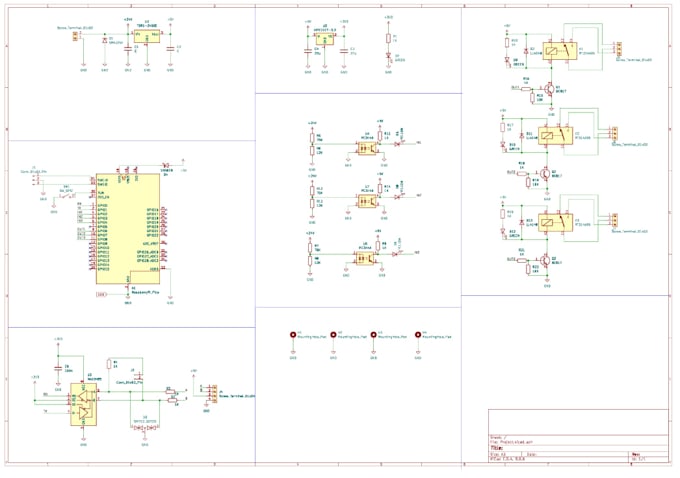
As an experienced PCB designer reviewing this schematic for the MCS IoT Controller Test Board (V1.0), it presents a straightforward test fixture centered around a Raspberry Pi Pico W microcontroller (U1) with its 40-pin breakout for probing GPIO, SPI, I2C, UART, and ADC functions, powered by a robust supply chain including a DC jack (U3), Schottky diode (U2) for reverse polarity protection, a 5V step-down regulator (U5: TSR 1-2450E), and a 3.3V LDO (U4: AMS1117-3.3) with basic decoupling (C1: 100nF). The design incorporates seven TEPT4400 phototransistors (U6-U12) configured as voltage dividers with 10K pull-down resistors (R1-R7) for analog or digital input simulation, a tactile switch (SW2: EVQ22705R) for basic user interaction, and a 0.96-inch OLED display (OLED1: HS96L01W4S03) for output visualization, though many net labels (NET1-NET9) remain unassigned to specific GPIOs, leaving peripherals floating and the overall connectivity incomplete. Test points (TP1-TP6) aid manual debugging, but the board lacks advanced QC features like current sensing for power consumption monitoring, GPIO expansion for full IoT protocol testing, or ESD protection, making it a solid starting point for basic functional verification but requiring refinements for comprehensive quality control of IoT controllers before client shipment.
